CERN’s new Director-General visits Bern
On 20 August, Prof. Mark Thomson, the new Director-General of CERN, paid an inaugural visit to Bern. A science policy panel discussion gave Swiss research-policy institutions and CERN an opportunity to look ahead together to the next chapter in particle physics and to recognise the close ties between Swiss stakeholders and CERN.
06.10.2026
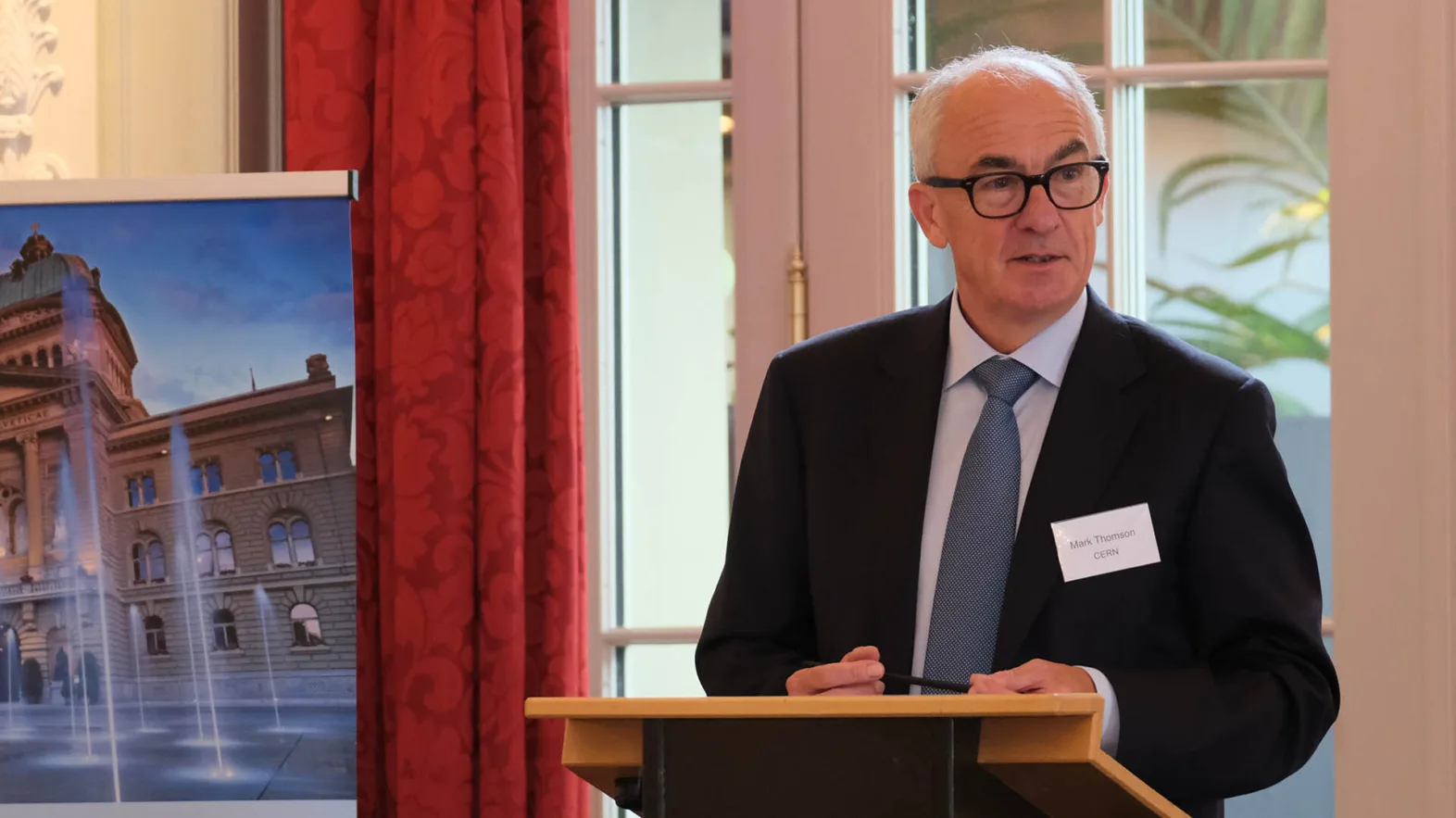
Switzerland and CERN closely linked
For Switzerland, CERN is not a distant research laboratory – and not just from a geographical perspective. CERN is deeply embedded in the country’s education, research and innovation system. Swiss universities are involved in major international collaborations to develop experiments and detectors for CERN. Many Swiss researchers who later go on to hold leading positions in academia and industry received part of their training through work on CERN’s instruments and experiments. Furthermore, Swiss initiatives supported by the federal government are developing the technologies that are likely to be used in a future accelerator.
Two initiatives illustrate this particularly well: CHART, which is driving forward accelerator technology, and CHEF, which is dedicated to the fundamental physics of a future accelerator. Both initiatives are supported by several Swiss institutions and were previously featured in an earlier article on how Switzerland is preparing for the future of particle physics.
Decades-long commitment
Few current research projects have such a long time horizon as CERN’s next major project. The Future Circular Collider (FCC) is the electron-positron collider identified by the European Strategy for Particle Physics as CERN’s preferred next major project. It would run through a new tunnel, approximately 91 kilometres long, beneath the Geneva region and cross the Swiss-French border. Its scientific programme would extend well into the second half of the century.
Securing the funding and political commitment for a project with such a long time horizon is a major challenge. This is all the more so given the current pressure on public budgets, as well as the rapidly changing research and geopolitical landscape. Furthermore, this is not a decision that Switzerland can take on its own: it rests with the CERN Council, on which Switzerland is represented as one of 25 Member States. As a first step, in May 2026, the CERN Council decided to update the European Strategy for Particle Physics. This document states that the FCC is the clearly prioritised major project for CERN. The decision on whether to proceed with the FCC is expected to be taken in the course of 2028 – that is, whilst the current Director-General is still in office. As the host country, Switzerland has a special role to play in this decision. The message conveyed by all representatives was accordingly clear: Switzerland wants to be prepared for this.
Switzerland as host state
State Secretary Martina Hirayama expressed this readiness in her address. She drew a parallel with the 1955 Headquarters Agreement, which continues to shape the relationship between CERN and Switzerland to this day. At the same time, she highlighted the concrete results of this partnership – foremost among them the numerous researchers whose training is supported by CERN and who often go on to pursue their careers in Swiss institutions or companies.
Looking to the future, she emphasised that Switzerland is preparing well in advance: In autumn 2024, the Swiss Parliament passed a law transferring responsibility for approving the construction of strategically important CERN projects on Swiss territory to the Swiss Confederation. Furthermore, Switzerland provides targeted support for the development of technology, research and young talent. In this way, Switzerland can fully fulfil its role as host country: CERN can rely on Switzerland.
CERN at an inflection point
'The FCC is the right choice for CERN and for particle physics. Our aim is to understand the Higgs particle, about which we still know very little,’ said Mark Thomson. He also emphasised that Europe is a leader in the field of particle physics: A major project is needed to defend this position.
He also commented on CERN’s special relationship with its host country, Switzerland. Several factors contribute to this positive relationship. In addition to geographical proximity and the excellent research facilities at the universities and at PSI, an innovative industrial sector also plays an important role. He likewise praised the coordination at national level through initiatives such as CHART and CHEF.
Prof. Thomson also pointed out that a major project such as the FCC has the potential to inspire younger generations and, particularly in times of geopolitical uncertainty, to send a message in favour of international cooperation.
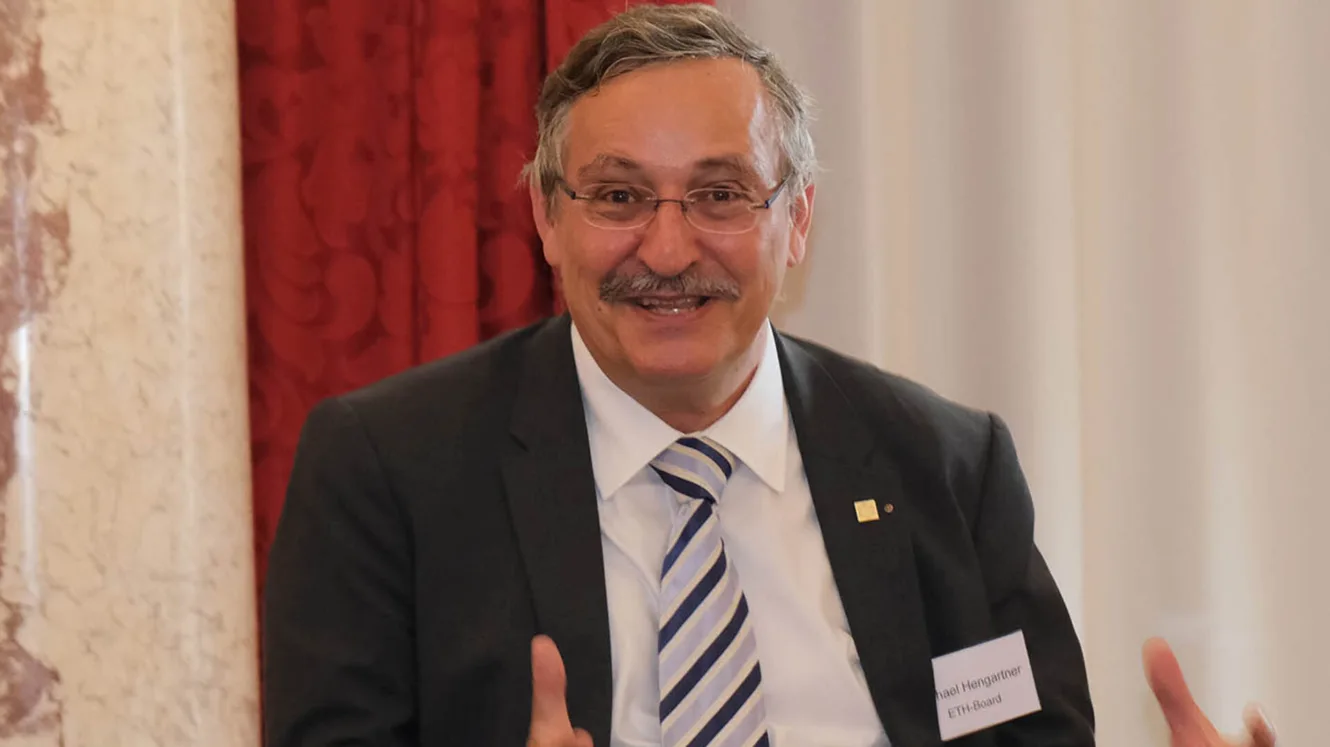
Outlook for Swiss research institutes
Prof. Michael Hengartner, President of the ETH Board, Prof. Luciana Vaccaro, President of swissuniversities, and Prof. Torsten Schwede, President of the Swiss National Science Foundation’s Research Council, all emphasised how indispensable fundamental research is. Hengartner pointed out that disruptive innovation is, in fact, almost always a by-product of fundamental research. Schwede is also convinced of this. He noted that, for example, the development of superconducting magnets for basic research in particle physics enabled groundbreaking methodological innovations in NMR spectroscopy, which in turn have highly relevant applications in the life sciences. Vaccaro highlighted the specialised skills that young researchers acquire at CERN, which make them highly sought-after professionals in the business world. A major project such as the FCC also exerts a strong pull on young talent and can inspire them to take an interest in STEM subjects. Her own professional career has also been shaped by CERN: It was the reason why she decided to study physics.
Contact
Francesca Stocker, SERI
International Research Organisations
francesca.stocker@sbfi.admin.ch
+41 58 467 67 96
Authors

Francesca Stocker

Doris Wohlfender
Related links
Read more
Mia Mader