ESA pursues ambitious goals under the motto ‘Elevate the Future of Europe’
At the ESA Council Meeting at Ministerial Level held in late November 2025, a strong signal was sent for the future of the European space sector. With a new strategy and a record budget in excess of EUR 22 billion, member states seek to expand ESA’s space infrastructure and make it more resilient. Autonomy, security and competitiveness are at the centre of the plans.
13.01.2026
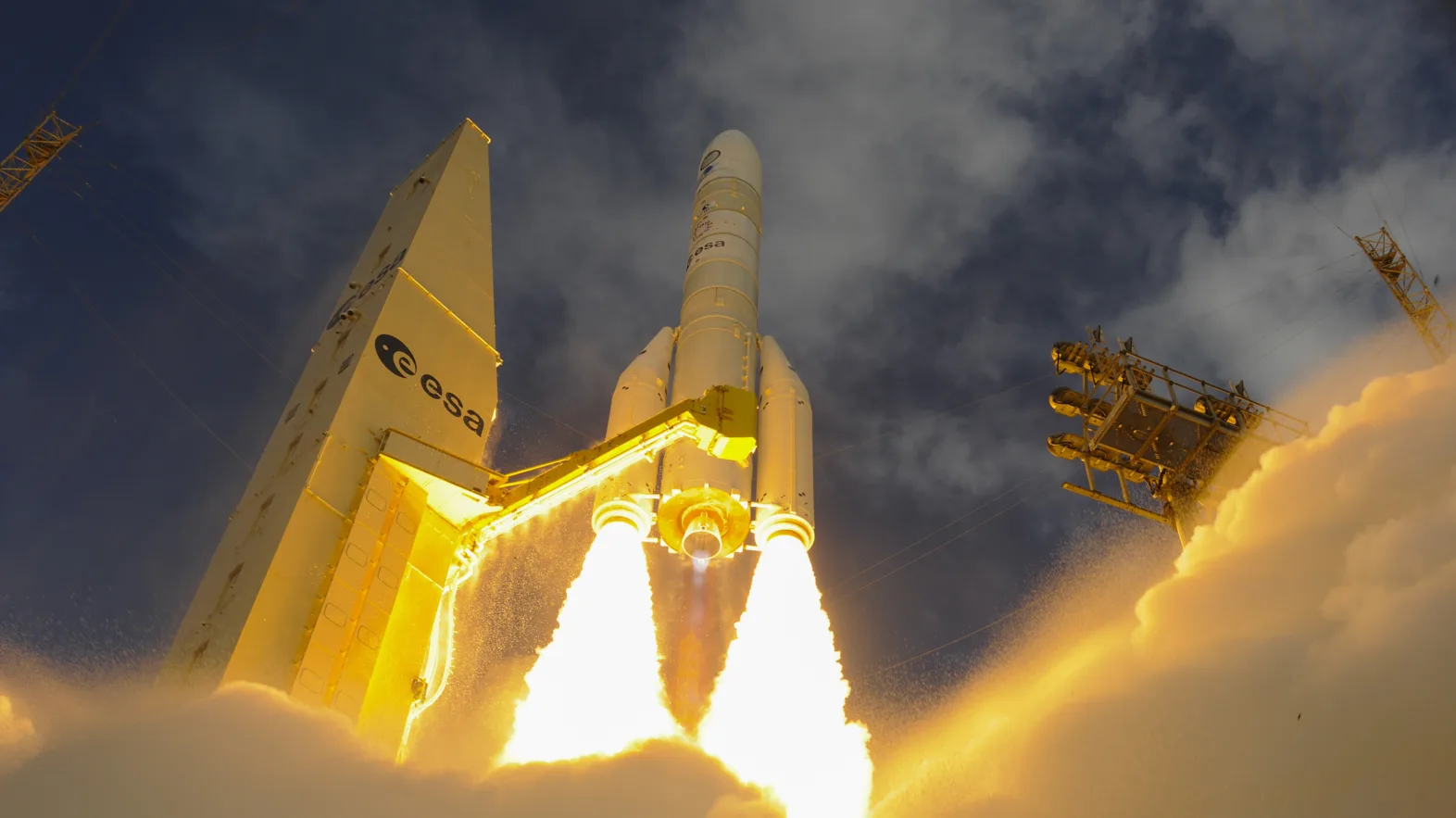
Enabling humans to survive in outer space has long ceased to be the main focus of space activities. While missions carrying astronauts into Earth’s orbit or to the Moon remain part of the picture, the real impact lies in the critical infrastructure that space activity enables – it spans the global and has become ubiquitous. Satellites continuously transmit signals for internet and telephony, television and weather imagery, as well as positioning data. Every person in Switzerland relies on these data and related services every day. Key sectors of our economy, such as transport and logistics, and essential service providers, including emergency and rescue operations, also depend on these data and services for their operations.
ESA's new strategy
The space sector has undergone a profound transformation over the past decade. The number of actors has surged, while entry barriers have fallen dramatically. In this fast-moving environment, staying competitive is essential. Recently, greater importance has been given to the use of satellites for security and defence purposes (e.g. reconnaissance and troop communications), creating a need to make this infrastructure more resilient. With the expansion of space activities, there is a growing demand for more flexible and cost-effective launch services to remain a relevant geopolitical player.
The 2025 Council Meeting at Ministerial Level of the European Space Agency (ESA) in Bremen took place under exceptional circumstances. Under the motto ‘Elevate the Future of Europe’, ESA aims to make the European space sector more autonomous, resilient and competitive. The agenda featured proposals for the continuation of current programmes and missions as well as for the addition of new ones. One such initiative is European Resilience from Space (ERS), which seeks to build a resilient and interoperable European infrastructure that can be used for both civilian and military purposes (dual-use). This includes high-resolution Earth observation (spatial and temporal), secure positioning and navigation and encrypted communications. Europe’s independent access to space also remains a top priority, currently ensured by the Ariane 6 and Vega C launch vehicles. To secure the future, the ESA has also issued the European Launcher Challenge, a call for tenders for companies offering innovative and more market-oriented launch services.
(Note: enable subtitles for the English translation)
Please activate marketing cookies to watch video.
Record-high expenditure
In Bremen, the member states endorsed this strategy and announced their financial contributions and priorities for the coming years. The ministers committed a record sum of approximately EUR 22.3 billion. For several programmes – most notably ERS and the European Launcher Challenge – allocations far exceeded expectations. In addition, the member states will continue to fund space exploration, the science programme, Earth observation, navigation and telecommunications, technology and space security as well as space transportation. The science programme received particularly strong support, which will enable ESA to further consolidate its leading role in space research.
As a sign of the growing importance of space activities, most member states have significantly scaled up their commitments – in some cases even more than doubling them. Switzerland also committed to contributing EUR 781 million, thereby increasing its involvement in ESA. It doing so, it also makes a clear commitment to strengthening the European space sector. In the coming years, Switzerland will focus mainly on programmes in technology and innovation, planetary defence and asteroid monitoring, navigation and quantum technology, as well as exploration and scientific instruments (Prodex). For example, in the HummingSat programme, a mini telecommunications satellites the size of a washing machine will be developed under the lead of a Swiss company. Switzerland is also actively supporting the Ramses mission, which will send a space probe to accompany an asteroid during its flyby of Earth. This probe will provide insights on how to handle future objects on a potential collision course with our planet.
With the agreed contributions and ESA’s planned programmes for the coming years, the European space sector is well positioned to demonstrate competitiveness, autonomy and resilience.
European Space Agency (ESA)
ESA is an international organisation headquartered in Paris. Founded in 1975, it now comprises 23 member states. Its programmes cover the full spectrum of space activities. Switzerland is a founding member and participates in nearly all ESA programmes. The agency operates under the principle of georeturn, meaning that a member state’s contributions flow back into its own industry and research in the form of contracts. Switzerland’s investments therefore also strengthen the economy and scientific community in Switzerland.
Contact
Author

Teresa Rudolph
Related links
Read more

Mia Mader
Francesca Stocker, …

Carole Egger